What's New I Sitemap I Bibliography I Vortigern Studies l POLLS I LINKS l Games I Sitemaster |
What's New I Sitemap I Bibliography I Vortigern Studies l POLLS I LINKS l Games I Sitemaster |
 |
Vortigern Studies > Fectio > Roman Sites > Sebatum 1983 |
Fectio Index
|
After visiting Aguntum and Lavant, Sebatum was very disappointing. True, it was just a passing visit on a trip to Bruneck/Brunico, but I had expected more. Still, a nice milestone by the way. Sebatum Sebatum,
present-day St.Lorenzen, was once the main settlement of
the Celtic Sevates. Here the calm Ahr river coming from
the Ahrntal valley and the Gader, a wild mountain torrent
coming from the Enneberg valley, flow into the Rienz, the
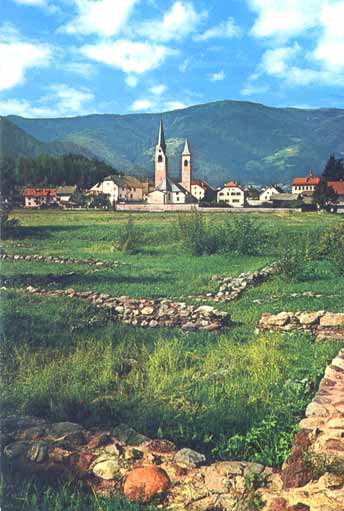
main river of the Pustertal valley. When the Romans reached the Pustertal valley back in 15 BC they already found an important shrine. In the recordings of the Roman historians the inhabitants of this area were called Sevates. Thanks to the building of the Via Claudia Augusta Altinate through the Pustertal valley, this settlement remained important. The battle for supremacy was lost, to Aguntum, the town of the neighboring Laianci. However some compromise was apparently reached because the new Civitas (province) was labelled civitas Sevatorum et Laianciorum. In the valley bottom of St.Lorenzen the native population mixed with the newly settled Romans. Here the Romans built a significant village with more than 1000 inhabitants and named it Sebatum after the native population. Numerous remains of walls in the surroundings of St.Lorenzen as well as the milestone next to Sonnenburg have been preserved from that time. In 1994 archaeological finds proved that a Christian church was built in Sebatum already at the time of the Roman Empire. It was consecrated to the Roman martyr Laurentius. The turbulent migration of peoples after the decline of the Roman empire in the 5th and 6th century led to a complete destruction of the old Sebatum. Due to the passage through of Hun, Gothic and Slavic armies the inhabitants of Sebatum withdrew to the mountains of Ladinia where Ladin, the language of the Rhaeto-Romans, has been preserved up to now. Sebatum itself however was completely depopulated. In the 6th century the Bavarians settled in the Pustertal valley. In the surroundings of St. Lorenzen they cleared woods, laid out fields and built farms and hamlets. With the
Christianisation under the emperor Charlemagne also the
church was reconstructed on the walls of the old Roman
temple of Sebatum. The name of the Holy Laurentius
originating from the Romans, however, has been preserved,
and so the new German village was called St. Lorenzen.
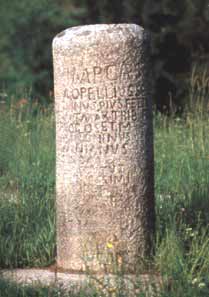
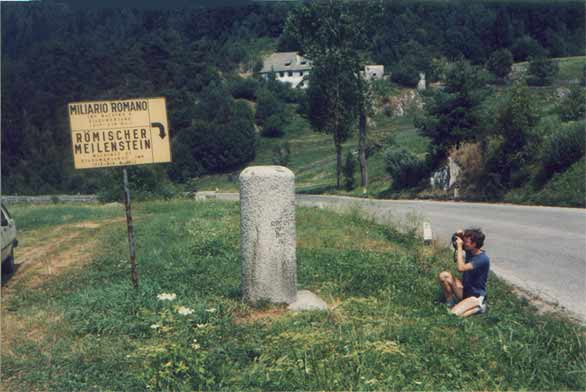
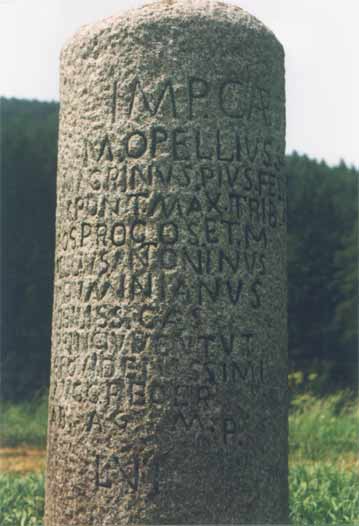
The Milestone In 1824 Count Giovannelli wrote that a milestone was found in the year 1723 during reparation works along the road. However, it had disappeared for quite a while and was only rediscovered in 1857 when a field wall was dismantled. From then on it was a constant subject of historical debate. J. A. Rohracher wrote that originally the stone had possibly stood at the crossroads to the Enneberg area, i.e. the present road to Maria Saalen, as usually mile stones were always placed at crossroads. Another constant topic of research was the question of the location of the town of Aguntum, in relation the villages of Littamum and Sebatum, mentioned in the Itinerarium Antonini, a traveller’s record from the end of the 3rd century AD. The so-called Oberdrauenburger Roman milestone (found in 1869 on the Carinthian-Tyrolean border), marked the distance to Aguntum as eight Roman miles. In 1873 Theodor Mommsen identified the Municipium Claudium Aguntum as the ruins next to the Debant Brook near Lienz in East Tyrol and was so able to definitely solve the problem of the location of Sebatum by means of the distance specification between Sebatum and Aguntum on the milestone from Sonnenburg. It is a milestone set up by Macrinus and Diadumenianus in 218 AD and was put there in connection with the route Veldidena - Aguntum - Teurnia. The honorary inscription is spread to 13 lines, lacks several letters and just shows the inscription: IMP.CAES. … … SSEVER…ARAB… … T …POT … … PRINCIPI OPT. … … … LVI Today the original is conserved at the Museum Ferdinandeum in Innsbruck. A copy from the 1870s can be seen on the road to Brixen, about 100m north west of the Sonnenburg.
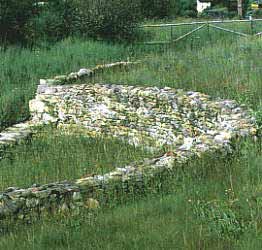
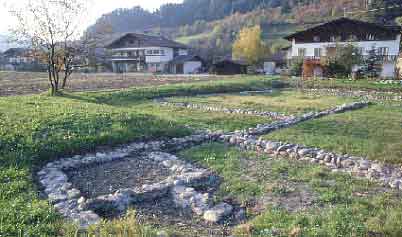
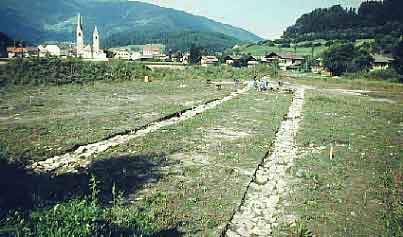
The visit On a trip through South Tirol, or the Puster valley in northern Italy we passed by the old Roman small town or road station of Sebatum. It was hot and disappointing, for only the remains of a few walls were visible, and nothing much of information. The stop was very brief as a consequence. A few miles down the road, however, stood the very good copy of a Roman milestone, with a sign as well. Museum
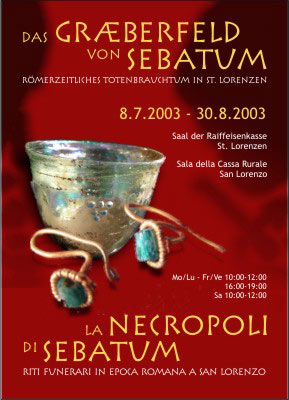
Antiquarium open: A new exhibition about Roman death cults in Sebatum is being held during the summer of 2003 in the local bank (click on the poster for more information). |
 |
VortigernStudies is copyright © Robert Vermaat 1999. All rights reserved |