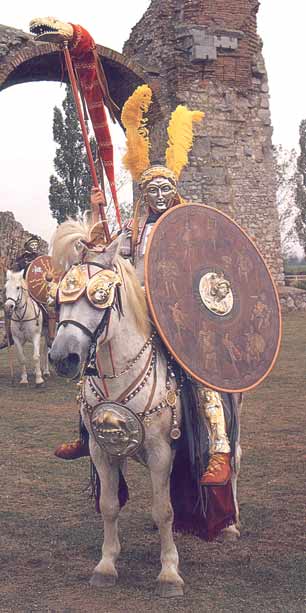
Fectio
Index




|
|

click here
|
The Draco,
the Late Roman military standardBy Robert Vermaat
|
| Origins:
Sarmatians, Alans, Parthians and Persians: The draco Standard was
originally developed by the cavalry peoples of
the steppes, such as the Sarmatians and the Alans,
but also by the Parthians and the Sassanid
Persians. It may have been used primarily to
determine the wind-direction for the horse
archers. Arrian described it as a long sleeve, 'made
by sewing pieces of dyed material together'.
This sleeve/tube hung limp when the rider was at
rest, but on the move it flew like a serpent and whistled
in the wind. The hollow head, in the form of
a toothed dragon, was formed from metal and the
wind passing through it would extend the cloth
tube tail attached to the neck of the head. The
draco was also used by the Dacians (or their
allies) and no less than 20 of these are shown on
Trajan's Column. Other sources mention
Parthian and Sassanid Persian dracos.
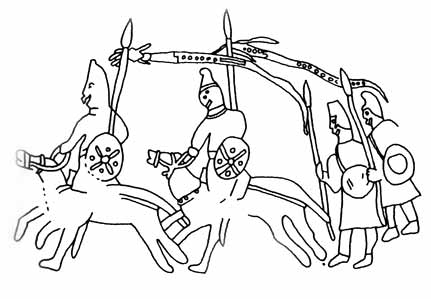
Not all such standards had dragon heads. The one
below on the left from Trajan's Column shows the
tubular tail with streamers attached. The head
looks more like a dog (with ears) than a dragon.
The one beside it has a much more serpentine head,
and has scalloped rings attached to the tail.
Other standards had no heads at all, just the
fabric tube, while some had heads looking like
wolves or even fishes. These had protruding ears
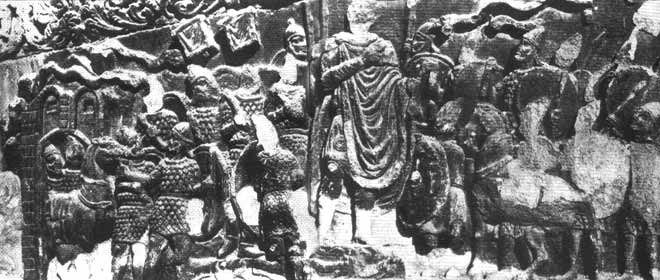
and fins. The images below show part of the Arch
of Galerius with several dracos.

A draco from Trajan's Column. |

Another draco from Trajan's Column. |
Several dracos on the Arch of Galerius (311AD),
carried by infantry as well as cavalry. |

4-5th-c. Coptic wall painting from Kharga
Oasis, Egypt, showing Sassanid dracos. |
Sassanid
Persian dracos main have been made of fabric only.
From the Historia Augusta we learn that when
Aurelianus had reconquered Palmyra (272 AD),
amongst the treasure were 'Persian dragon-flags'
(Persici dracones)[1], which to me sounds like the
standards we're discussing here. What these draco
may have looked like we can see below; on the
extreme right is a 5th c. AD Coptic wall painting,
showing the occupying Sassanid Persian forces
carrying two dracos.
The
Roman draco
The Draco was
adopted first into the Roman cavalry during the 2nd
century AD, possibly with the introduction of
Sarmatian cavalry into the Roman army. Arrian,
who was writing c. 137 AD, described it as a Scythian
(he most probably meant Sarmatian) invention
which was adopted by Roman cavalry[2]. The Romans first began to use
the draco in cavalry games, the so-called 'Hippica
Gymnasia'. These were described by Arrian
as glamorised versions of training exercises,
performed in decorated armour. It is possible
that the draco was introduced just because it was
'outlandish', foreign and glamourous. Points in
the game were scored for strikes on the tail
piece of the dracos carried by a team acting as 'targets',
from dummy javelins thrown by another team of
riders. Arrian recommended that the standard be
colorful, adding to to the spectacle of cavalry
parades. One should be given to each unit to
maintain order in both displays and battle. The
Roman cavalry adopted the draco probably during
or after the Dacian wars, in which the equipment
of the Roman cavalry was altere to withstand the
charged of the lance-armed cavalry. These
equipment changes included the adoption of the
fully-armed cavalry (alae cataphractiorum)
and the long lance. It would be logical to assume
that this was the time when also the draco
standard was introduced.
The choice for
the dragon/serpent as model is not so easy to
explain, because the steppe cultures used other
animal's heads and continued to do so. However,
it has been assumed that it was because of the
Thracian dominance in Roman cavalry that the
latter adopted the serpent shape. These Thracian
horsemen had a deity which resembled a 'flying'
serpent with scales, teeth and an upstanding
crest, which may well have been a draco or
something similar.
It is not
documented when exactly the draco was adopted as
a normal standard for all troop types. However,
sources mention the draco being used with the
infantry. The Historia Augusta mentions
that the mother of Severus (193-211 AD) dreamt of
a puple snake before his birth, something very
alike what we later hear of the Imperial standard[3]. But since this source
was probably compiled later, we can't be sure
this has any bearing on a dating. We are on more
solid ground with the entry of the reign of
Gallienus (253-268 AD), when legionary troops are
said to have paraded with a dracon amongst the
standards of the legions[4] and the
troops of Aurelianus (270-5 AD) also had draconarii
amongst the standard-bearers[5]. This may lead us to conclude
that the infantry began using dracos during the
late 3rd c. On the Arch of Galerius, which was
built before 311 AD to commemorate Galerius' war
against Persia in 290 AD, several dracos can be
seen to his left and right, carried by infantry
as well as cavalry (see the image above, 2nd from
right).
We have no good
idea about the general appearance of the draco.
Some draco heads may have looked like a draco,
but some seem to look more like wolves or dogs,
or even of an ass (..).
 |
|
Also, we can't be sure of
the lenght of the windsock, or the actual
length of the pole on which it was
carried. However, the coins of the
Emperor Trajan Decius (AD 249-251) give
us some idea as to tall the latter was.
If not a representation of a boar-headed
trumpet (carnycus), it does not
seem to have been taller than a man. In
my opinion though, the Emperor would
rather be shown with an standard.
|
 |
The draco head was most probably
constructed by first carving a wooden original,
then beating a copper alloy sheet around it. This
draco head was made of two halves, the bottom jaw
being riveted against the top half. Adding a
windsock may be a problem, because we have no
clear idea how long it would be. However, trial
and error will get you there, with of course
different lengths and materials possible. I'd go
for silk, which may be expensive, but it is light
and gets the best result. Possibly, added hoops
might keep the tail 'inflated', which can also be
used to attach strips of cloth to create the 'streaming'
effect of the flying beast described by Arrian (Ars.
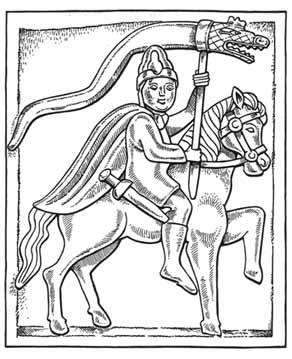
Tact. 35.3-4). The images below show a 2nd-3rd
C. funeral stele from Chester, probably showing a
Sarmatian draconarius.

The funeral stele from Chester.
|

Reconstruction of the stele from Chester.
|

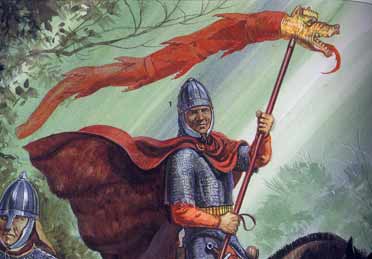
Reconstruction drawing by Gerry Embleton,
showing a Sarmatian in Roman service,
based on the Chester stele as well as the
'dog' draco from Trajans Column.
|

Anoter view of the Niederbieber
original.
|
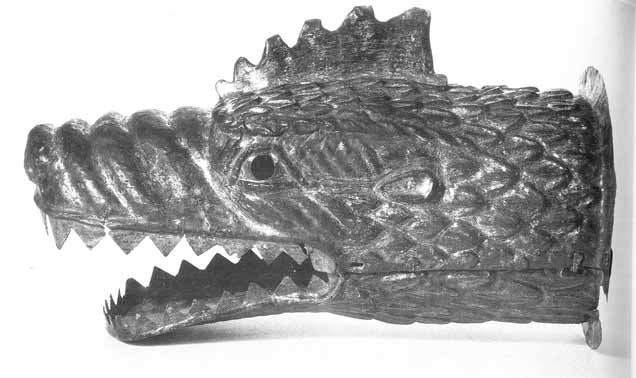
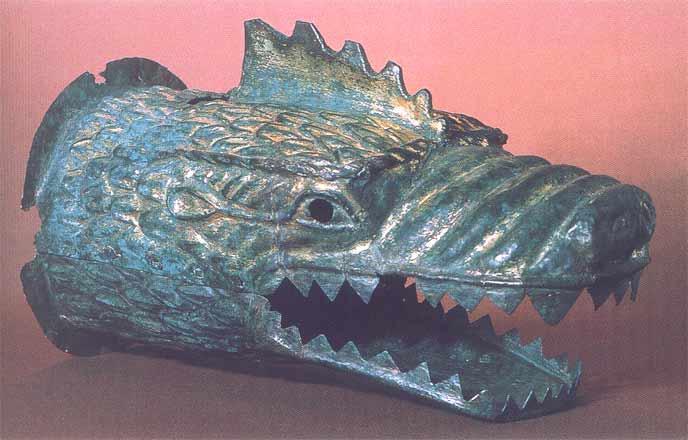
The Niederbieber draco
The Roman draco
developed into a real dragon, without ears but
with scales and a crest. The only fully preserved
draco was found in the Limes fortress of
Niederbieber in Germany, which dates to the 3rd
century. This copper alloy object was discovered
near the SW edge of the vicus (civilian
settlement) outside the fort. It can best be
described as a scaled monster's head, measuring
30x12x12 cm, and with some probability is the
head of a cohort's draco.
It is formed by the joining of two embossed
sheets, the gilded upper one overlapping the
lower tinned one, both attached by 5 rivets on
each side. At the base of the neck the sheets
form a circular flange, riveted together by 2
more rivets. Overlapping scales cover the head
and neck, while a series of ridges covers the
upper jaw from the nostrils to the eyes, which
face sideways. The open mouth shows triangular
teeth, but no fangs or canines. A crenellated
crest is attached to the top of the head.
Two holes of similar size are pierced through
both the throat and the skull behind the crest.
No doubt a staff or the shaft of a spear would
pass through here. Two axial slits, 2 cm long,
pierce the botom of the lower jaw, probably to
attach a lost mechanism that would have produced
the hissing effect.

The Draco found in Niederbieber,
Germany. |

Reconstruction drawing by Eiden.
The head is about 30 cm long, 12cm high (with
comb 17 cm), and 12 cm wide. |

The Niederbieber draco. |
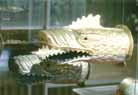
Another shot of these reconstructions in
the Mainz museum. |
The
draco in the Late Roman army
The late 4th c.
author Vegetius also mentions the draco as a
common standard. He seems to have been confused
about the difference between the old standards
and the new dragons though, as he wrote that
apparently standard- and draco-bearers differ[6], but also that the
standardbearers 'are now named dragonbearers[7], that both are present in a camp[8], but also that each cohort has a
draco[9]. if correct it would mean the
first overall standard for the cohort (where
before none had existed between the legionary aquila
and the signa of the centuries). the
draco may have foreshadowed the later common
practise in the 3rd century to permanently detach
cohortes from their parent legions.
By 357 AD, the
Emperors Constantius and Julian (who was crowned
by a draconarius[10]) had personal dracos
sewn from a purple material. Ammianus Marcellinus
writes of flags as well as draco being purple[11] and mentions them making a
hissing sound in the wind[12]. The Emperor's personal
draco standards made them identifyable in the
heat of battle and may therefore have been mainly
a tactital instrument rather than a personal
adornment. Julian's draco at the battle of
Argentorate (357) was important in his attempt to
regain control of the battle[13]. The early 5th/c. author Zosimus
also mentions Julian being extremely cross when
one was lost to the enemy during the Persian
campaign[14] .
By the fifth century, as may be deduced from
inscriptions from Perge and Prusias/Üskübü,
Turkey, as well as a poem by Prudentius, there
was a rank called magister draconum.
This officer was the superior of the draconarii
in a unit, ranking immediately below the tribune.
However, we don't know if he directed the draconarii
in battle, or may just have been the head of the
standard bearers' club or scholae. The magister
draconum probably replaced the optio
signiferorum, whose function unfortunately
is equally vague. Other ranks are less clear:
from Cagliari/Sardinia we know an optio
draconarius, while the bearcus
draconarius seems to have been an unusually
high-ranking draconarius.
Prudentius also tells us that Late Roman draconarii
wore golden torcs as reward for their valor in
battle. However, we learn from Ammianus that the
torc may have been a badge of office, so possibly
standard bearers were selected from those who had
earlier received such torcs, marking them for an
elite.
The East
Roman or 'Byzantine' draconarius
Around the mid-6th
century, the historian Johannes Lydos mentioned
the draconarius (drakonarioi-drakontophoroi)
in a list of ranks and functions[15]. Justinian also mentioned a corps
of 10 draconarii in his edict of 534, issued to
Belisarius in North Africa[16]. The military manual called the Strategikon
of the emperor Maurikios (582-602 AD) shows that draconarii
were probably still around in the early 7th.
century. However, it is not clear whether the draconarius
mentioned there [17] was already
anachronistic or if he still had a proper
military function - there was a scholae
draconariorum, a non-military office staff
of 10 clercs attached to a civilian praefectus
praetorio. After the 6th century, the draconarius
disappeared from the Byzantine army.

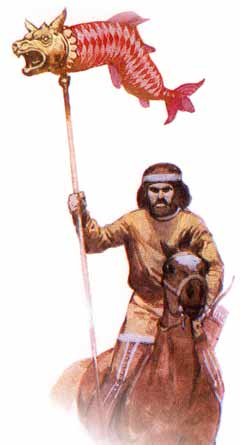
Reconstruction drawing by Angus McBride,
showing a Parthian 'fish'. |

Reconstruction drawing by Peter Conolly,
showing the Hippica Gymnasia
described by Arrian. |

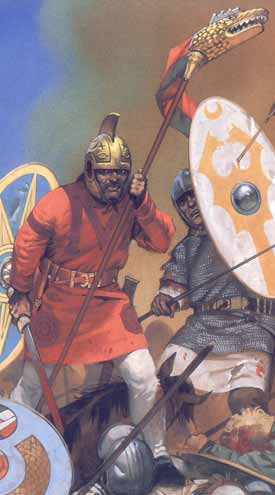
Reconstruction drawing by Angus McBride,
after the Villa Maria catacomb fresco. |

Reconstruction drawing by Richard Hook,
with windsock. |
After
the Romans
Dracos continued
in use in the Caucasus and Georgia, while in the
West the Franks under Charlemagne may have
adopted them again. This may show continuity, or
else Charlemagne's attempts to eminate the Roman
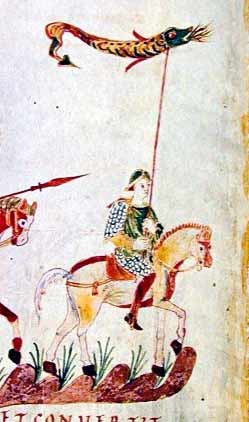
Army. We have a miniature from the late 9th-c. Psalterium
Aureum (MS St. Gall. Stift-Bib. 22, fol. 140,
illustrating Psalm 59), which shows a draco in a
formation of heavy cavalry.
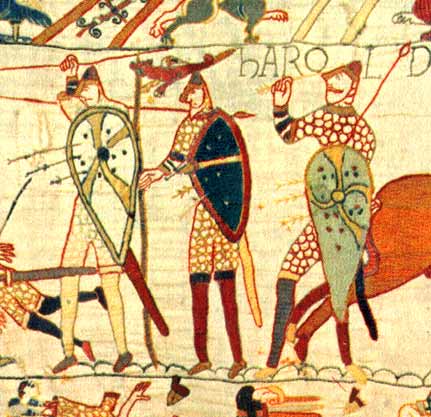
We also see
it used at the battle of Hastings in 1066 AD,
where it is carried by Harold Godwinson's
retainer at the moment of his death.
The next image is from a 14th-century manuscript
of L'Histoire de Merlin by Robert de
Boron, now in the Bibliotheque Nationale in Paris.
It shows King Arthur in combat, brandishing what
can only be a Medieval representation of a Late
Roman draco. This is not supposed to reflect 14th-c.
battle standards, but rather a fanciful idea of
ancient use.
The last image shows the flag of modern Wales, in
Welsh called Y Draig Goch (The Red
Dragon). This red dragon, as the tale goes, would
go back to the myth of the red and white dragons
fighting on Vortigern's fort at Dinas
Emrys in Gwynedd, Wales. These dragons,
though, are thought by some to represent the
draco of the Late Roman army.
The Dragon of Wessex, like the Red Dragon of
Wales, may indeed represent some form of
continuity. However, it could also show Francish
influence in England and Wales during the early
Middle Ages, as well as an antiquity-related
Romanticism which has nothing to do with reality
any more.
|

Fectio's reconstruction of what such a
fabric draco may have looked like.

The reconstruction from Marcus Junkelmann.
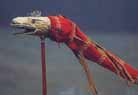
A draco for the Carnuntum Archaeological Park.

Another shot of the Carnuntum draco.

A draco from Joe Piela.

The reconstruction by Michael Simkins.

Another shot of the reconstruction by Michael
Simkins.

A reconstruction by Cezary Wysczinski.

The Britannia draco.

Close-up of the Votadini draco.

The Foederati draco,
reconstructed by Toni Feldon.

The Timetrotter draco, also by Toni
Feldon.
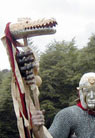
The Time Team draco, made by Tim Blades.

The Comitatus draco, also by Stefan
Jaroschinski.

The Fectio draco.

The Fectio draco, made by Stefan
Jaroschinski.

Fectio's draco.

Jeroen with the Fectio draco.

Another draco by Stefan Jaroschinski. |
See
also:
Special thanks to Sander
van Dorst for providing the Greek quotes below:
Notes
[1] Scriptores Historiae Augustae,
Aurelianus 28.4:
| tunc illatae illae vestes,
quas in Templo Solis videmus, consertae gemmis,
tunc Persici dracones et tiarae,
tunc genus purpurae, quod postea nec ulla genus
detulit nec Romanus orbis vidit. |
Then were brought in
those garments, encrusted with jewels, which we
now see in the Temple of the Sun, then, too, the
Persian dragon-flags and head-dresses,
and a species of purple such as of nation ever
afterward offered or the Roman world beheld. |
[2] Arrianus, Tactica 35:
| ... Sèmeios de
diakerimenoi epelaunousin, ou tois Rhoomaikos
monon alla kai tois Skythikois, tou poikilooteran
te kai hama phoberooteran gignesthai tèn elasi.
Ta Skythika de sèmeia estin epi kontoon en
mèkei xymmetrooi drakontes apaiooroumenoi.
Poiountai de xyrraptoi ek rhakoon bebammenoon,
tas te kephalas kai to sooma pan este epi tas
ouras eikasmenoi ophesin, hoos phoberootata hoion
te eikasthènai. Kai ta sophismata tauta
atremountoon men toon hippoon ouden pleon è
rhakè an idois pepoikilmena es to katoo
apokremamena, elaunomenoon de empneomena
exonkountai, hooste hoos malista tois thèriois
epeoikenai, kai ti kai episyrizein pros tèn agan
kinèsin hypo tèi pnoèi biaiai dierchomenèi. |
'... They attack
separated by standards, not only the Roman but
the Scythian ones as well, so the charge becomes
more colourful and fearsome at the same time. The
Scythian standards are snakes of equal length
held up on top of spearshafts. They are made of
coloured pieces of cloth sewn together, the heads
and their entire body up to the tail resembling
serpents, so in order that they appear thus more
frightening. And when the horses are not
trembling from them the multicoloured bodies can
be seen hanging down, however when charging they
fill with air through the wind so they are most
like the beasts and even hiss when a strong wind
flows through much movement.' |
[3] Scriptores Historiae Augustae, Severus
4.1:
| ..mater eius pridie quam
pareret somniavit se purpureum dracunculum parere,
.. |
The night before he was
born his mother dreamed that she brought forth a
purple snake, .. |
[4] Scriptores Historiae Augustae,
Gallieni ii 8.6:
| Hastae auratae
altrinsecus quingenae, vexilla centena praeter ea,
quae collegiorum erant, dracones
et signa templorum omniumque legionum ibant. |
On each side of him were
borne five hundred gilded spears and one hundred
banners, besides those which belonged to the
corporations, and the flags of auxiliaries and
the statues from the sanctuaries and the standards
of all the legions. |
[5] Scriptores Historiae Augustae,
Aurelianus 31.7:
| Templum sane Solis,
quod apud Palmyram aquiliferi legionis tertiae
cum vexilliferis et draconario
et cornicinibus atque liticinibus diripuerunt, ad
eam formam volo, quae fuit, reddi. |
Now as to the Temple of
the Sun at Palmyra, which has been pillaged by
the eagle-bearers of the Third Legion, along with
the standard-bearers, the dragonbearer,
and the buglers and trumpeters, I wish there
is restored to the condition in which it formerly
was. |
[6] Vegetius, Epitoma rei militaris 1.20:
| ... Quid ipsi draconarii
atque signiferi, qui sinistra manu hastas
gubernant, in proelio facient, quorum et capita
nuda constant et pectora? ... |
... What are the dragonbearers
and standardbearers, which hold spears in their
left hand, to do in battle, whose heads and
breasts are naked ? ...' |
[7] ibidem 2.7:
| ... Signiferi qui
signa portant, quos nunc draconarios
vocant. ... |
'... Standardbearers who
carry the standards, whom they now call dragonbearers.
...' |
[8] ibidem 1.23:
| ... Porta autem, quae
appelatur praetoria, aut orientem spectare debet
aut illum locum, qui ad hostes respicit, aut, si
iter agitur, illam partem debet adtendere, ad
quam est profecturus exercitus, intra quam primae
centuriae, hoc est cohortes, papiliones tendunt
et dracones et
signa constitutum. ... |
'... The gate though,
which is called the commander's, must either face
east or to that spot, which faces towards the
enemies, or, if a march is conducted, must be
directed to that part, towards which the army is
to march out, at the inside of which the first
centuries, that is cohorts, set up tents and dragons
and standards are pitched. ...' |
[9] ibidem, 2.13:
| ...Dracones
etiam per singulas cohortes a draconariis
feruntur ad proelium ... |
'Dragons, one each for
the individual cohorts, are carried into battle
by dragonbearers.' |
[10] Ammianus Marcellinus, 20.4.18:
| Eoque adfirmante
primis auspiciis non congruere aptari muliebri
mundo, equi phalerae quaerebantur, uti coronatus
speciem saltem obscuram superioris praetenderet
potestatis sed cum id quoque turpe esse
adseveraret, Maurus nomine quidam, postea comes,
qui rem male gessit apud Succorum angustias,
Petulantium tunc hastatus, abstractum sibi
torquem, quo ut draconarius
utebatur, capiti Iuliani inposuit confidenter,
qui trusus ad necessitatem extremam iamque
periculum praesens vitare non posse advertens, si
reniti perseverasset, quinos omnibus aureos
argentique singula pondo, promisit. |
'But since he insisted
that at the time of his first auspices it was not
fitting for him to wear a woman's adornment, they
looked about for a horse's trapping, so that
being crowned with it he might display at least
some obscure token of a loftier station. But when
he declared that this also was shameful, a man
called Maurus, afterwards a count and defeated at
the pass of Succi, but then a standard-bearer of
the Petulantes, took off the neck-chain which he
wore as carrier of the dragon
and boldly placed it on Julian's head. He, driven
to the extremity of compulsion, and perceiving
that he could not avoid imminent danger if he
persisted in his resistance, promised each man
five gold pieces and a pound of silver.' |
[11] ibidem,
15.5.16:
| ... nihil tutum ex
praesentibus ratus in consilia cogebatur extrema
et sensim cum principiorum verticibus secretius
conlocutus isdemque magnitudine promissae
mercedis accensis, cultu purpureo a draconum
et vexillorum insignibus ad tempus abstracto ad
culmen imperiale surrexit. |
'... So Silvanus, seeing
no safety under present conditions, was driven to
extreme measures, and having gradually spoken
more boldly with the chief officers, he aroused
them by the greatness of the reward he promised;
then as a temporary expedient he tore the purple
decorations from the dragon standards
and vexilla of the cohorts and the companies, and
so mounted to the imperial dignity' |
[12] ibidem, 16.10.7:
| ... purpureis
subtegminibus texti circumdedere dracones
hastarum aureis gemmatisque summitatibus inligati,
hiatu vasto perflabiles et ideo velut ira perciti
sibilantes caudarumque volumina relinquentes in
ventum. |
'... the dragons,
sewn from purple covers and placed on the gilded
and jewel-studded tips of spears, letting wind
through an enormous opening and in that way
hissing as if they had been aroused in anger and
the bodies of their tails flowing in the wind.' |
[13] bidem,
16.12.39:
| Quo agnito per purpureum
signum draconis, summitati
hastae longioris aptatum velut senectutis
pendentis exuvias, stetit unius turmae tribunus
et pallore timoreque perculsus ad aciem
integrandam recurrit. |
'On recognising him by
the purple ensign of a dragon,
fitted to the top of a very long lance and
spreading out like the slough of a serpent, the
tribune of one of the squadrons stopped, and pale
and struck with fear rode back to renew the
battle.' |
[14] Zosimus,
Historia Nova 3.19:
| |
Meanwhile Surenas,
advancing with a large army from a town in
Assyria, surprised the reconnoitring party in
advance of the army, killed one of the three
tribunes and some of his men, and put the
remainder to flight, carrying off a military
ensign which was in the form of a dragon, such as
the Romans usually carry in war. The emperor on
learning this was much displeased, and in his
anger attacked the forces of Surenas, compelled
all to fly that could escape, retook the ensign
which the enemy had carried off, and coming
immediately to the city where Surenas had
surprised the party, stormed, took, and burnt it.
As the commander of the party, preferring his own
safety to the valour and honour of a Roman, had
left his standard in the enemy's hands, he
deprived him of his girdle, regarding him as a
mean and worthless person, together with all who
had accompanied him in his flight |
[15] Johannes
Lydos, De Magistratibus, 1.46:
[16] Codex
Justinianus I.27.1:35)
| In schola
draconariorum hominibus decem annonae xi capita
xs solidi xcvii. ita: primo annonae ii pro annona
solidos v, capitus is pro capitu solidos iiii,
fiunt solidi xvi. reliquis hominibus novem ad
annonam i pro annona solidos v et ad capitum i
pro capitu solidos iiii, fiunt solidi lxxxi. |
'To
the ten men in the corps of standard bearers (draconariorum):
to the first, five solidi for an annona, and 1 1/2
capitus, 4 solidi for an annona, making 16 solidi;
to the remaining nine men, 1 annona each, 5
solidi for an annona, and 1 capitus each, 4
solidi for each capitus, making 81 solidi.'
|
[17] Maurikios,
Strategikon, 12.7:
| |
'There should be drill
masters, standard bearers or draconarii,
trumpeters, armorers, weapon makers, bowmakers,
arrow makers, and the rest according to
regulations.' |
Bibliography 
Sources
- Ammianus
Marcellinus:
the Later Roman Empire (AD 345-378), trans.
Walter Hamilton, notes by Andrew Wallace-Hadrill,
(Penguin Classics, London, 1986).
- Ammianus
Marcellinus
on the internet: http://penelope.uchicago.edu/Thayer/E/Roman/Texts/Ammian/home.html.
- Arrian: Tactica. Flavii Arriani
Quae Exstant Omnia, edited by A. G Ross. 2 vols.,
(Leipzig. B. G. Teubner, 1968).
- Historia Augusta, at: http://penelope.uchicago.edu/Thayer/E/Roman/Texts/Historia_Augusta/home.html.
- Mauricos: Strategikon, Handbook
of Byzantine Military Strategy, trans. by George
T. Dennis, (Philadelphia 1984).
- Vegetius: Epitome of Military
Science, trans. N.P. Milner, translated texts for
historians vol. 16. (Liverpool 2001).
- Zosimus: Historia Nova, ed. and
trans by Buchanan, James J., and Davis, Harold T.,
(Trinity University press, San Antonio, Texas,
1967), pp. 249-58.
Secondary
literature
- Bishop, M.C. and J.C.N.
Coulston (1993):
Roman Military Equipment, from the Punic Wars to
the Fall of Rome (Batsford).
- Brzezinski, R. and
M. Mielczarek (2002): The Sarmatians, 600 BC-AD
450, Osprey Men-at-Arms 373, (Wellingsborough).
- Coulston, J.C.N. (1991): The 'draco'
standard, in: Journal of Roman Military
Equipment Studies 2, pp. 101-14.
- Fischer, Thomas (1999): Die Römer in
Deutschland, Theiss Verlag, Stuttgart.
- Junkelmann, Marcus (1990-2): Die Reiter Roms,
3 vols., (Mainz).
- Macdowall, Simon
and Howard Gerrard (ill.) (2001): Adrianople 378 AD,
Campaign 84, (Osprey, London).
- Nicolle, David and
Angus McBride
(ill.) (1996): Sassanian armies, The Iranian
Empire, early 3rd to mid-7th centuries AD, (Montvert,
Stockport).
- Oelwein, Cornelia (1998): Römer in
Deutschland, (HB Bildatlas 20).
- Shadrake, Dan,
Susanna and Richard Hook (ill.) (1997): Barbarian Warriors,
Saxons, Vikings, Normans, Brassey's History of
Uniforms 7, (Brassey's, London).
- Speidel, M.P. (1985): The Master of the
Dragon Standards and the Golden Torc: an
Inscription from Prusias and Prudentius'
Peristephanon, in: Transactions of the
American Philological Association 115, pp
290-5.
- Sumner, Graham and
Graham Turner
(ill.) (1997): Roman Army, Wars of the Empire, Brassey's
History of Uniforms 8, (Brassey's, London).
On the internet
|